Kanade begins with a farewell that cannot be performed as neatly as planned. The person staying behind wants to send someone off brightly, yet their face does not cooperate. That small failure opens a larger change. This reading moves from a wish to hold on, through a reconsideration of protection, toward a voice that can travel where the speaker cannot.
A sincere wish can coexist with a difficult goodbye
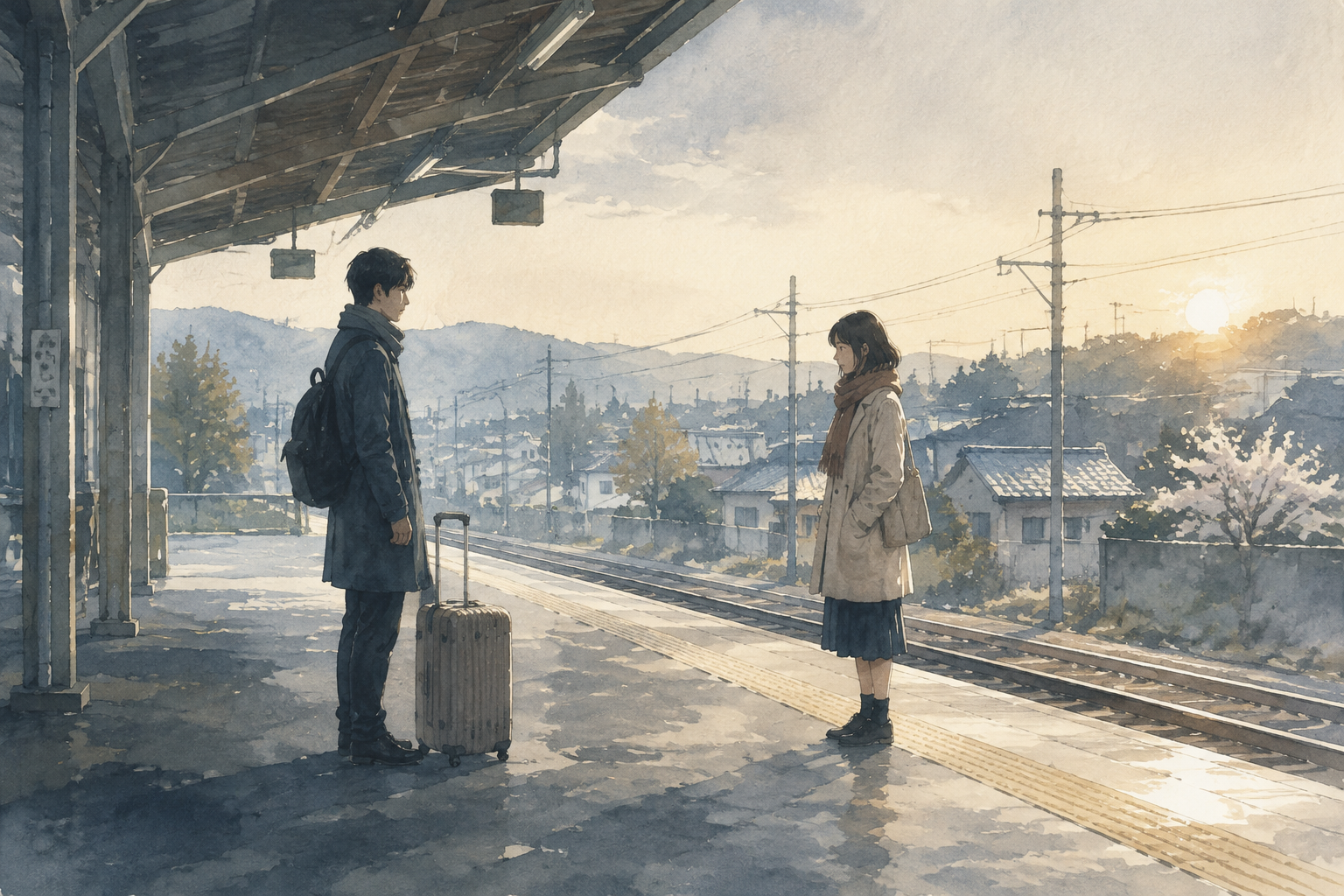
The station continues its ordinary activity while the departure matters intensely to two people. The contrast makes the hesitation recognizable. Supporting another person's next chapter does not automatically make it easy to lose their daily presence. A cheerful goodbye would be convenient, but an inability to produce one does not prove that the support was false.
The song refuses to choose between affection and sadness. If loving someone were supposed to remove every selfish or frightened feeling, this farewell would become evidence of inadequate love. Instead, its difficulty makes room for a more human account. Wanting the departure to go well and wanting another minute together can belong to the same person at the same time.
Shared time replaces the need to lead

A turning point comes when the speaker reconsiders the belief that guiding the other person is their own essential role. There is a move toward trusting the time already spent together. That history can support both people as they change, without requiring one to remain permanently in charge of the other's direction.
This makes the departure more than a change of address. An established relationship can also require a change in how someone understands their usefulness. Accepting another person's independence may mean surrendering the comforting idea that they always need your hand to move forward. In this interpretation, the farewell is difficult partly because the speaker is practicing that surrender while still wanting to offer care.
The song becomes something that can be sent

The sudden urgency of departure does not settle into a declaration that the relationship is over. The voice looks for a form of connection that can survive distance. A song can be heard in another place; it does not need the two listeners to stand in the same station. The ending therefore changes what the speaker's presence might mean rather than merely repeating a wish to stop the journey.
Consider returning to a familiar recording after a move. For a few minutes, it can bring a shared history into an unfamiliar room without making the distance disappear. This everyday analogy extends this interpretation; it is not a claim about a scene in the video or the musicians' lives. The song's hope is not that nothing will change. It is that change does not have to make every earlier connection inaccessible.
A question for your next listen
Compare the first attempt to say goodbye with the final attempt to make a voice reach someone far away. What can the song do that the farewell sentence cannot? Listening for that change keeps Kanade from becoming only a story about holding on: it is also about finding a different way to accompany someone.
Sukima Switch released Kanade (奏/かなで) on March 10, 2004. Takuya Ohashi and Shintaro Tokita share the writing and composition credits. The official SukimaSwitchVEVO music video is embedded below. The interpretation concerns the song's speaker, not a claimed episode from either musician's private life.
This reading follows the Japanese lyrics; it is commentary, not a full lyric translation. The illustrations are imagined scenes.