The dance in Sakanaction's Shin Takarajima is easy to remember. The voice in the lyrics is doing something less immediately triumphant: continuing a piece of work whose destination is not yet settled. Listening for that unfinished effort changes the song's optimism. It becomes encouragement for someone still making the next attempt, rather than a celebration reserved for someone who has already arrived.
The next line comes before the complete map

The recurring forward movement need not mean that progress is effortless. The important contrast is between continuing and arriving. The former remains possible while the latter remains uncertain. That distinction prevents the song's energy from becoming a simplistic promise that sufficient enthusiasm will automatically produce the result you want.
Consider someone revising a drawing. A complete picture in the imagination can be intimidating because the first marks inevitably fall short of it. Yet looking at those marks can reveal a decision that was impossible to make while the page remained blank. This is an analogy for the reading, not a scene the song describes. An attempt supplies information. The value of the next attempt may therefore be that it makes the problem clearer, even before it makes the work better.
Care is a practice, not the absence of trembling
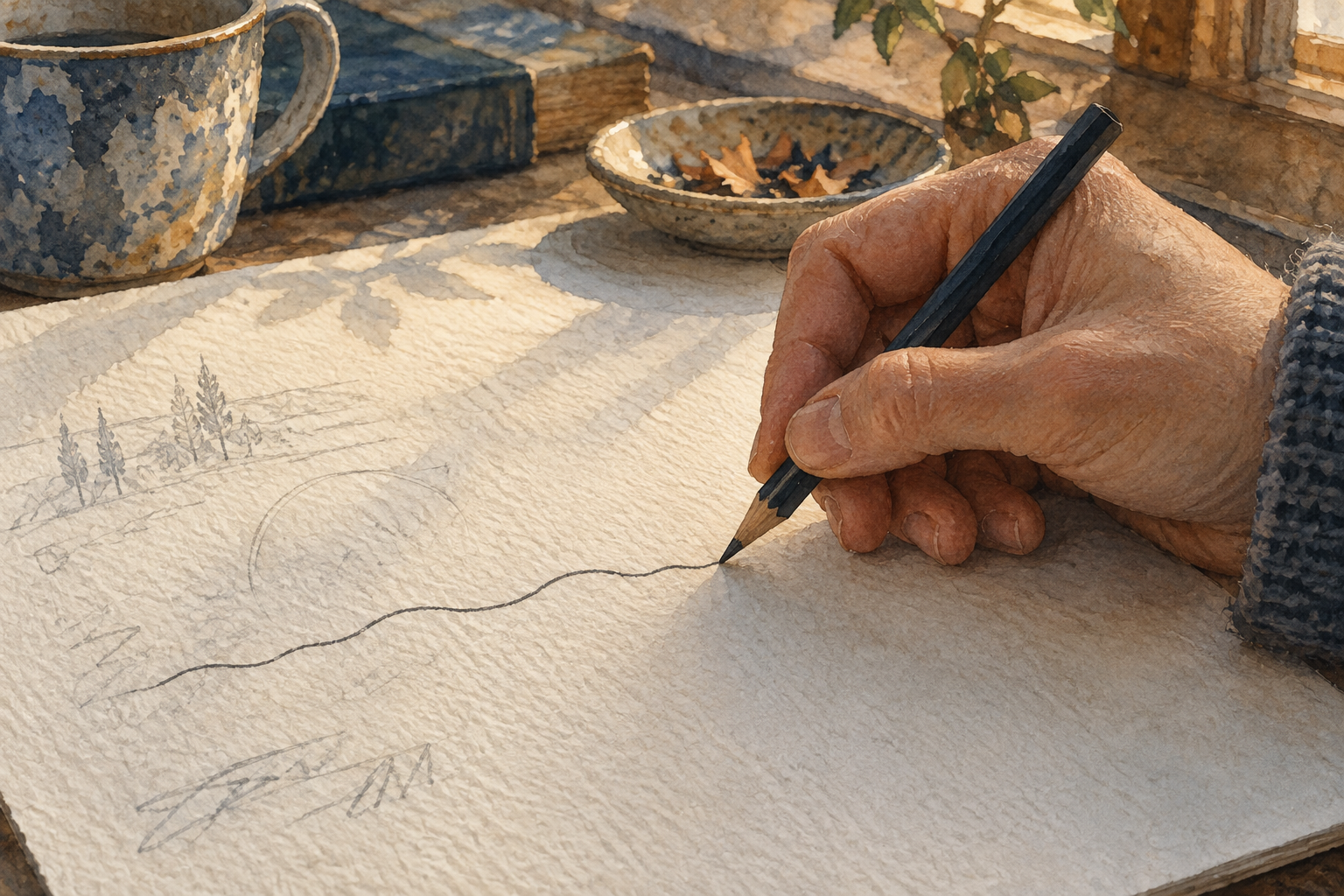
The combination of care and an unsteady line is the central tension here. A polished result and a serious effort are not interchangeable measures. We can hear the speaker's commitment as something maintained within uncertainty. Waiting for every sign of hesitation to disappear would make confidence a prerequisite for creating anything at all.
That does not turn the song into permission to stop paying attention. A rough sentence may deserve another revision; an awkward musical phrase may need practice. Accepting an imperfection and refusing to work on it are different responses. A useful question is whether a flaw identifies a specific next action, or has become a reason to dismiss the whole person making the work. The first question can guide another attempt. The second can prevent the attempt from happening.
Who will receive what you are making?

The final turn in this reading is toward the person the speaker wants to reach. Making something is not only a private test of competence. It can also be an effort to share a way of seeing. Heard through that relationship, the destination matters partly because it is somewhere to go together. It is not simply a prize to possess alone.
There is no need to assign that other person a fixed identity. An artist and a listener provide one possible lens; two people imagining a future provide another. The illustrations choose a drawing table as a visual metaphor, without claiming to depict the songwriter or the music video's story. On another listen, let the thought of a recipient change the earlier passages about persistence. Continuing can mean wanting to make contact, not merely wanting to prove that you can finish.
A question for your next listen
Listen once for the repeated actions, then again for the person toward whom they are directed. Does the second listen make the persistence feel different? Keep care and imperfection in the same frame: removing either one makes the song's encouragement less interesting.
Shin Takarajima (新宝島) was released by Sakanaction on September 30, 2015. Ichiro Yamaguchi wrote the lyrics and music. The official music video below is separate from the imagined watercolor scenes used in this article.
This reading follows the Japanese lyrics; it is commentary, not a full lyric translation. The illustrations are imagined scenes.