When someone you love is struggling, it is tempting to promise that you will fix everything. Receiving help yourself can then feel like a failure to keep that promise. Back Number's Mabataki offers a gentler way to think about the relationship. Its image of protection matters, but so does the question of who is allowed to need it. This reading follows the movement from offering care to accepting that care may also come back toward the speaker.
An umbrella changes what you can do, not the weather

The song's account of happiness moves away from the idea of an uninterrupted supply of extraordinary experiences. A small act of shelter becomes more important. An umbrella is a useful image because it has a limit: it does not remove the rain from the world. Read this way, the speaker does not have to become powerful enough to eliminate every difficulty before being able to help another person. The value is in responding to the person within reach. That is a more specific promise than simply declaring that everything will be fine.
An everyday comparison might be a friend who has had a terrible day at work. You may be unable to change the workplace, but you can ask whether they want company, a meal or someone to listen. This is an application of the metaphor, not an event described in the lyrics. The question matters: help that makes the giver feel heroic is not necessarily the help the other person wants. The umbrella image becomes more useful when we imagine it as something offered and accepted, rather than proof that its holder knows best.
The voice offering care is not invulnerable

The song leaves room for different kinds of lives rather than measuring everyone against one grand ambition. Alongside that generosity comes the speaker's own uncertainty. A person explaining happiness is not necessarily someone who has mastered it. The wish to be useful and the fear of falling short can occupy the same voice. That tension makes the declaration feel less like a finished philosophy and more like a direction the speaker is trying to live toward.
If we hear only an unlimited promise of protection, we lose that vulnerability. Waiting to become a perfect person would postpone almost every act of kindness; promising more than we can sustain creates a different problem. There is room between those extremes for an honest sentence such as, ‘I cannot solve this tonight, but I can stay and listen.’ That imagined sentence is not a translation of the song. It describes the kind of limited, repeatable care that this reading brings into focus. The limitation does not make the care worthless. It makes the promise something another person can understand.
Letting the direction of care change
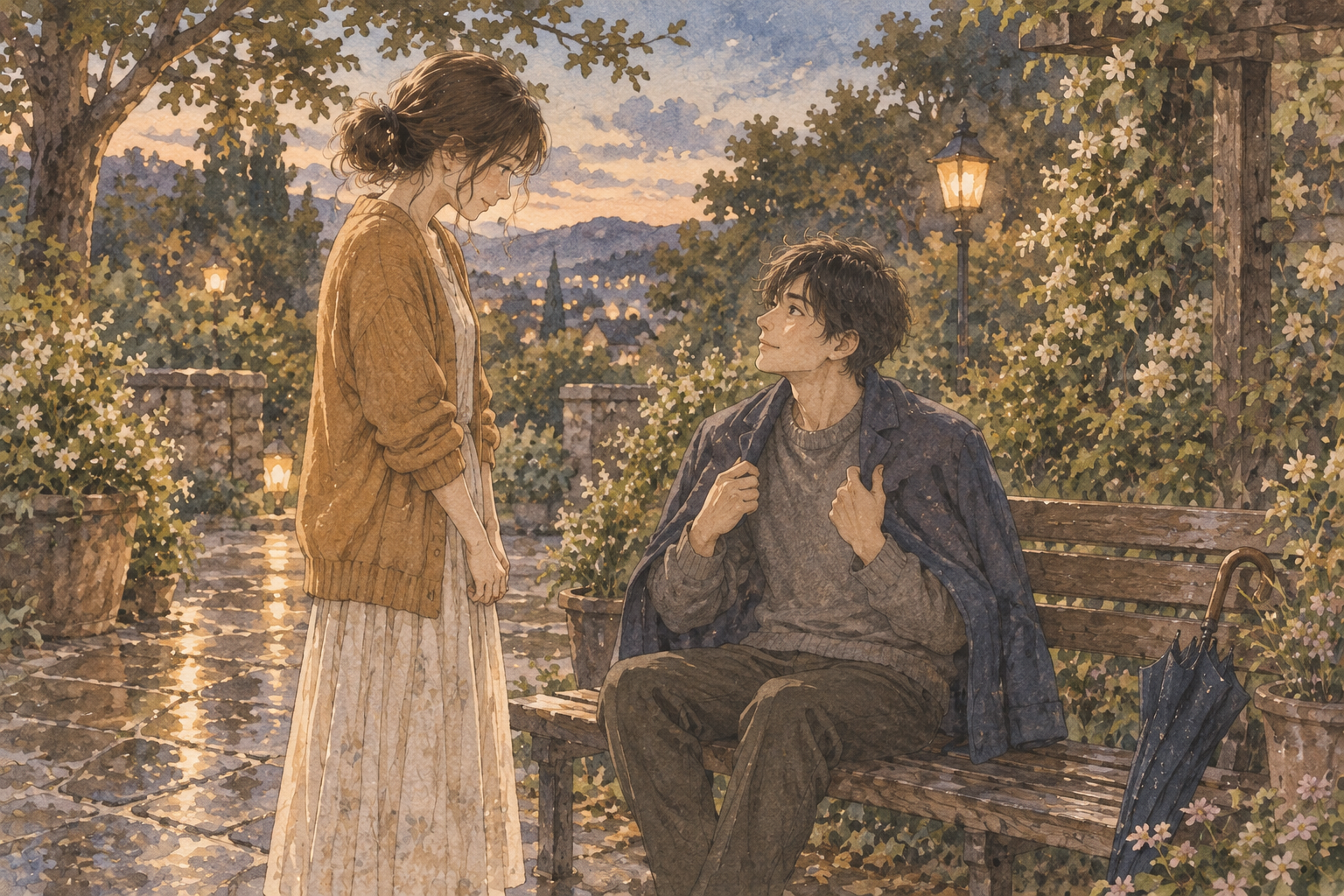
Near the ending, the speaker also occupies the position of someone being protected. I hear that shift as an expansion of the earlier idea, rather than a withdrawal of it. The person who wants to offer shelter belongs inside the relationship's care too. If the opening image assigned one person a permanent job—strong protector—and the other a permanent need, this later movement loosens the arrangement. Being helped does not automatically cancel the sincerity of wanting to help.
That is different from keeping a ledger. Reciprocity need not mean exchanging equal amounts of support on every occasion. One person may have more capacity today, and less tomorrow. The important permission is to let that become visible. In a relationship where someone hides every small need out of embarrassment, the other person may never know when to reach back. For this reading of Mabataki, the most revealing question is therefore not how much the speaker can provide. It is whether the speaker can accept a place among the people who deserve gentleness.
A question for your next listen
Compare the early and late descriptions of care, paying attention to who needs shelter. Does allowing the speaker to receive help make the earlier promise weaker, or more sustainable? The answer is an invitation to listen closely, not a claim about the songwriter's private intentions.
Mabataki (瞬き), meaning a blink, was released on December 20, 2017 as Back Number's seventeenth single. It is the theme song for the film 8-nen Goshi no Hanayome: Kiseki no Jitsuwa. Lyrics and music are credited to Iyori Shimizu, with arrangement by Takeshi Kobayashi and Back Number. The player below is the official music video.
This reading follows the Japanese lyrics; it is commentary, not a full lyric translation. The illustrations are imagined scenes.