A child who repeatedly claims to know nothing about the world is nonetheless certain of one thing: that another person's hand feels warm. In "The Story of Six Years and One Night," it is precisely this sense that undergoes the most profound change. Rather than chasing the rapid succession of events, attending to what remains unknown when words are repeated—and what has finally been understood—makes the boy's inner state far more distinct.
To say one knows nothing is to acknowledge that the chance to learn has been taken away.
The narrative introduces an unnamed era and village alongside an unnamed boy. Merely by virtue of being born, he is treated as an ominous presence. What he repeatedly claims not to know is not difficult knowledge; rather, it consists of the tenderness behind a scolding or the warmth felt in another person's hands—things a child should have learned in daily life.
It is equally significant that the sensation of intense cold breaks through only after claiming there is nothing sad. This does not sound like a calm born from an absence of suffering, but rather like a voice accustomed to pain without having fully understood other ways of living. The loneliness easily masked by the song's rapid tempo resides within this repetition.
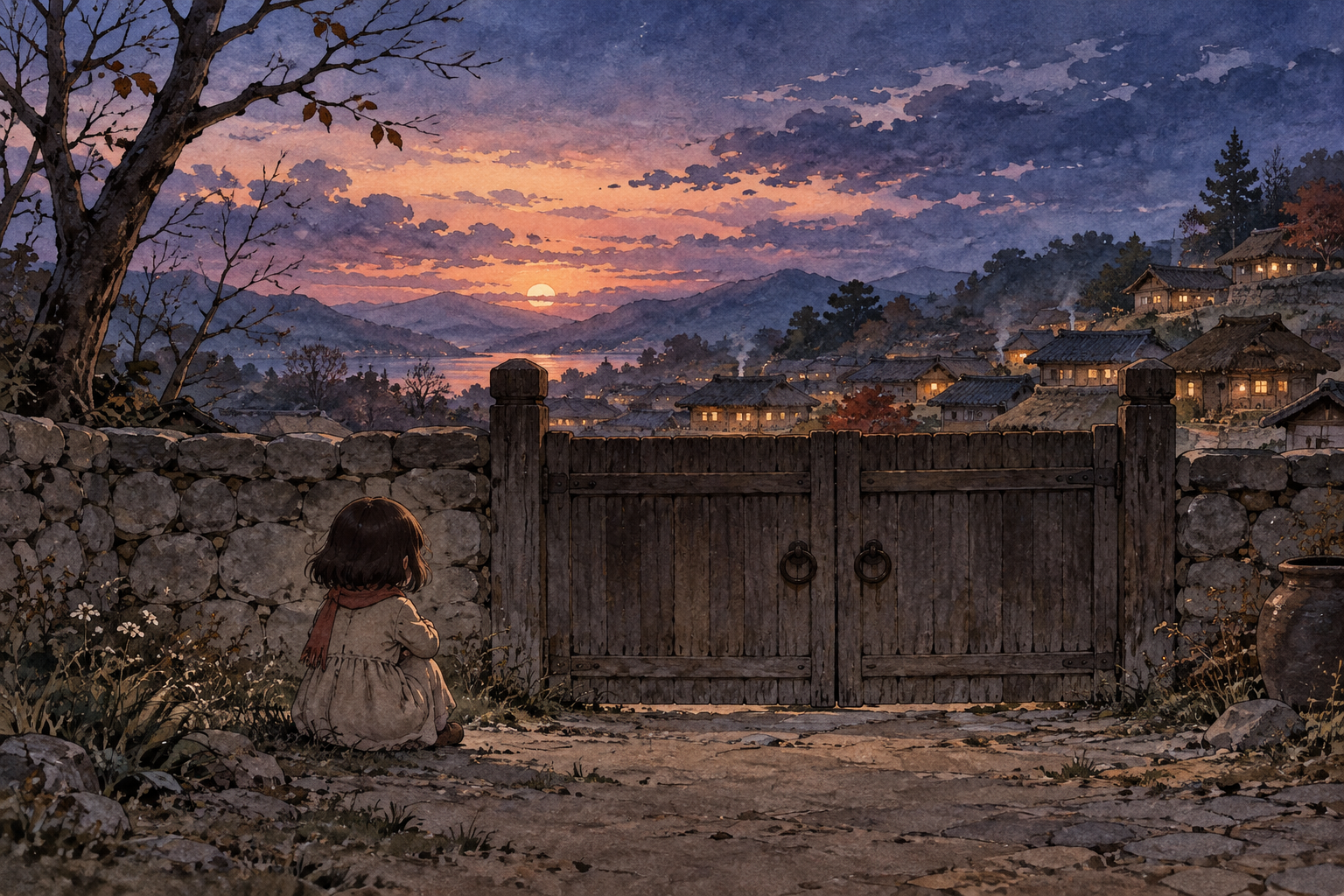
Photo: Original Korean article
A single warmth from a hand emerges in a world full of the unknown.
The other person asks the boy for his name and takes his hand, inviting him to go home together. The boy has no place to return to and no name by which to describe himself, yet the other initiates a relationship. Before the stigma of being ominous can take hold, they simply speak to one another and stand side by side.
The word 'I don't know' persists into the second chorus as well. However, where there was once a sense of coldness, the warmth of an unfamiliar hand now takes its place. It is the feeling that even without knowing many things, this one thing is real. The fear of being exposed and facing danger has not vanished, but the boy is no longer enduring the world through his own solitary sensations.

Photo: Original Korean article
The relief at the end is not the same as a bright ending.
In the latter half, a wish for just the two of them to remain is followed by a vast scene in which everyone else disappears. The song does not fill this process with realistic explanation; instead, it pushes forward like an old tale. As a result, it is difficult to conclude that everything has been set right simply because the boy feels at ease. A sense of unease lingers alongside the relief.
Even at the end, the boy remains ignorant of what lies ahead and of his companion's name. The ignorance that has persisted since the beginning is unchanged; yet now he feels that things are fine as they are. Whether this constitutes a complete salvation or merely a fleeting respite within a closed world is left open to interpretation. Listening to the coldness of the first chorus alongside the sentiment of the final section reveals both what one relationship changed and what ultimately remained unresolved.

Photo: Original Korean article
Listen along with the track details
Open the official video on YouTube
This is a song for IA produced by kemu, released in April 2012 as the fourth work from KEMU VOXX. Although a novel with the same title was later published, it is best not to treat details absent from the lyrics as definitive.
The player above features the original KEMU VOXX track for IA, uploaded to ke-sanβ's video production channel. Rather than summarizing the novel's plot, this reading focuses on how emotions shift through the recurring scenes of ignorance, cold and warmth, and being led by hand within the song.
Introduction to KADOKAWA works and original stories
KEMU VOXX original song video
If this song resonated with you
Kanzaki Io – Being Hated by Life: It is useful to compare the flow of despair toward the world shifting into a desire to live alongside another person.
In Aimer's 'LAST STARDUST,' one can trace the faith that remains in hand, even when salvation is far from complete.